
It started with a simple question: what if a card collection could feel like a place you could visit? Our first answer was Rare Habitat, a personal Pokémon collection turned into an explorable world. Then came the more interesting question: could someone else make one with their own cards?
The objective
We wanted a repeatable path from a public collection showcase to a personal site. A visitor would name their world, provide a public Collectr showcase URL, and carry a clear handoff into ChatGPT. From there, a focused plugin would guide the build: verify the visible cards, choose the residents, and make a site that feels like their collection.
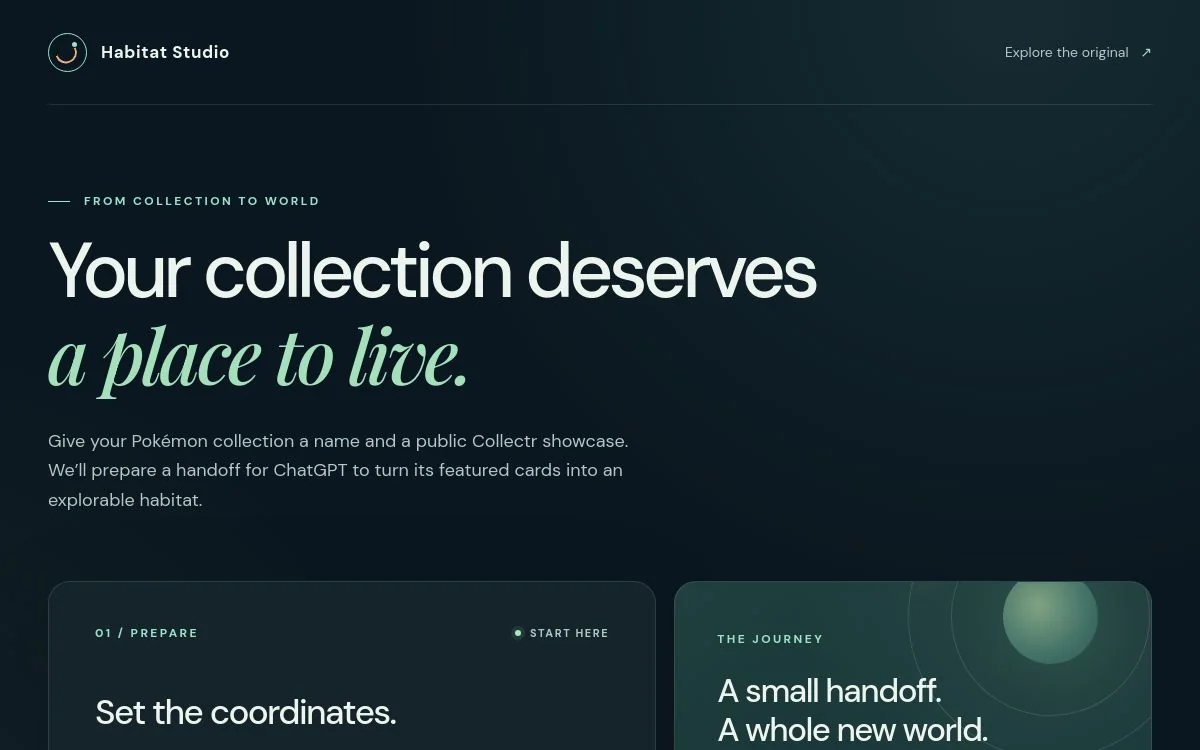
Two pieces, one journey
We built a public generator called Habitat Studio and our first custom ChatGPT plugin to work together. The generator creates a structured handoff from the visitor’s site name and showcase URL. The plugin turns that brief into a build workflow: inspect what the public showcase actually reveals, make a verified roster, then build an original habitat around it.
That distinction matters. A public showcase may show only part of an account, and a page may fail to load in a particular ChatGPT session. The workflow asks for a pasted card list when it cannot identify the holdings with confidence. It does not invent a collection or call a limited public view a full account sync.
Then we tried it for real
We ran a second collection through the flow and built Test Habitat. The visible showcase gave us five verifiable card entries representing three Pokémon. The finished site turned those residents into an illustrated map with distinct regions, a searchable card collection, encounter details, and a two-Pokémon exhibition battle. The map can be moved and zoomed; the experience also works on smaller screens.
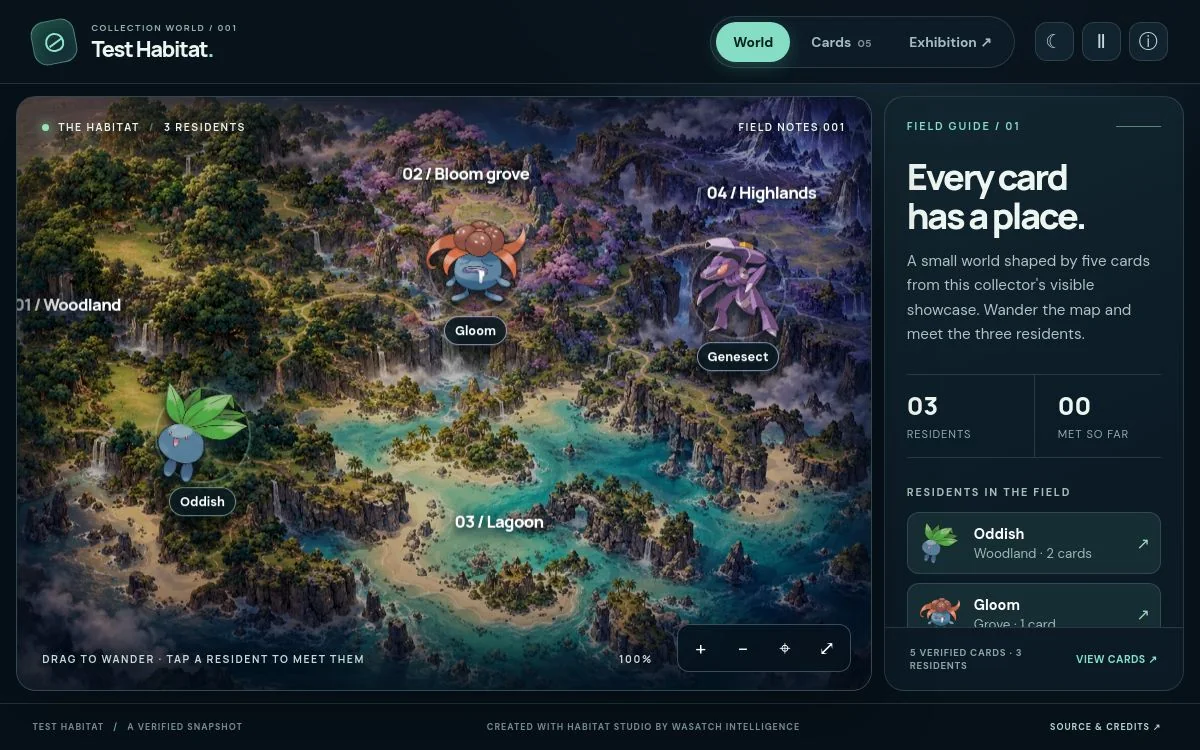
The test also taught us where the edges are. Reading a public page is not the same as having a supported account integration. The URL-first route is an experiment, so the handoff keeps a human fallback for cards the plugin cannot verify. The generator is public; the plugin and end-to-end build remain a private pilot while we keep testing how well the flow travels between accounts.
Why we kept going
Rare Habitat was one world. Habitat Studio asks whether the process behind it can become a tool someone else can use. That is the part we love about the Lab: build the thing, try it with a different starting point, and let the next version answer a better question.
Explore the public Habitat Studio generator. The plugin is in private testing, so the public site is a look at the flow rather than an open installation path.